


When you hop aboard a bicycle and learn how to ride, there is this moment of truth as you try to maintain your balance and build momentum. It doesn’t feel possible that picking up speed will make staying balanced easier, yet that is precisely what happens as you pedal with more confidence and purpose.
Bicycle Thieves is a film that immerses you in that wobbly state between forward momentum and crashing out. Its protagonist, Antonio Ricci, never takes full flight, nor does he succumb to total disaster. He is, as the film takes pains to illustrate, one of many wobbling nervously and precariously ahead.
Ricci’s movements about Rome—or more accurately within and among masses of other Romans—are the crux of the film. Lamberto Maggiorani, the actor who plays Ricci, has movie star looks, but was in real life untrained and a factory worker. Perhaps because of this authenticity, he exudes pathos, whether as a seemingly triumphant provider for his family or as a desperate man trying to claw back what has so quickly and unfairly eluded him. It is the backdrop of Rome—the real, unvarnished, staggering post-war Rome that Italian Neorealism made central to its movement—though, that gives the story real heft.
Without an unending supply of other would-be Antonio Riccis bustling around the actual Antonio Ricci that has our attention on this day—without understanding that he is one of many—this would not land in the same way.
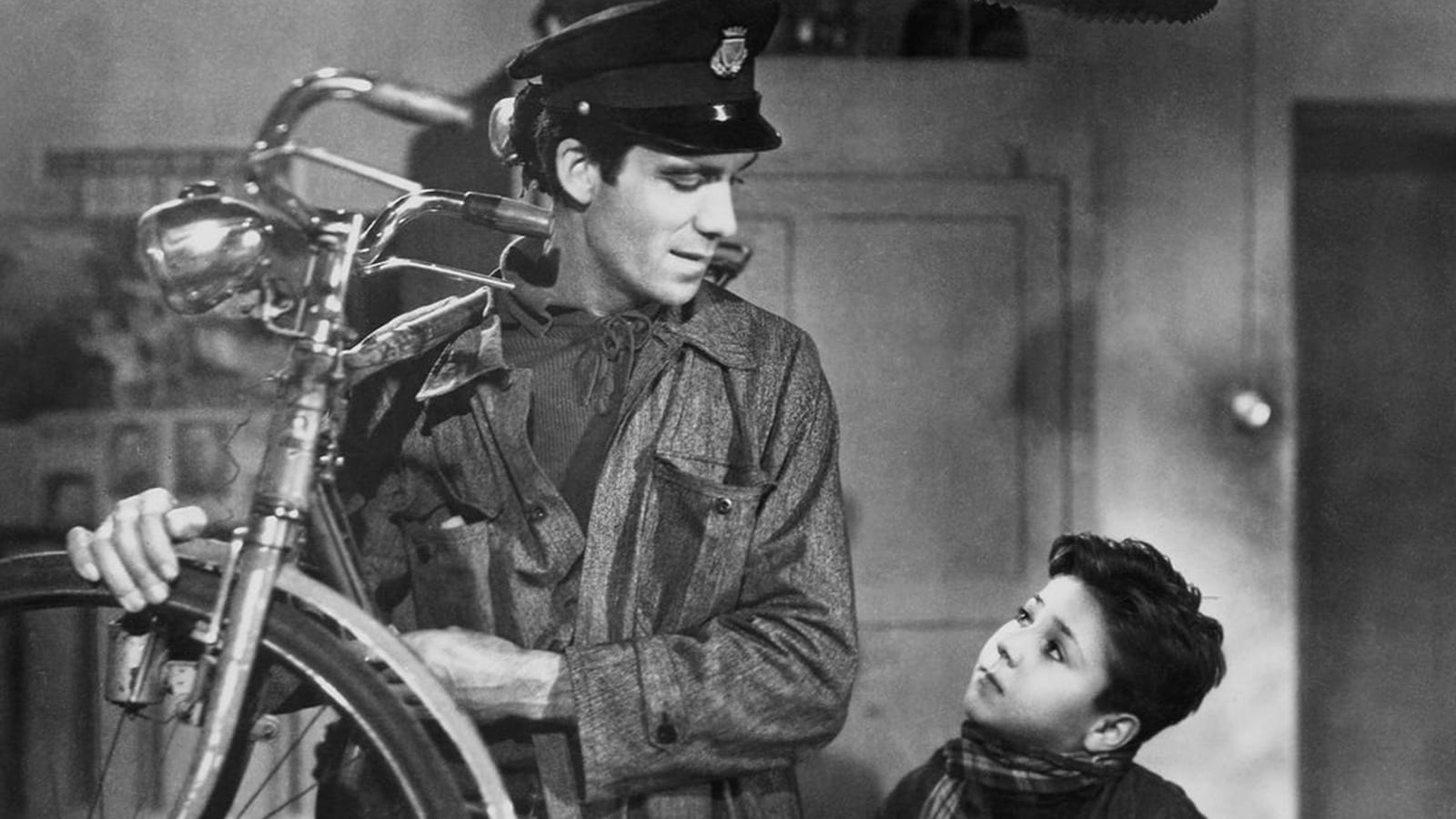
In that sense, Bicycle Thieves is a film that trains your eyes downward. It does so figuratively, in the context of class—we are meant to consider what those living on the edge like Antonio must navigate—but also literally. After Antonio’s wife pawns their bedding so he can get his bicycle back and take a job putting up posters around the city, we are, because of the title of the film, waiting for it to be plucked away from his grasp. There it is, almost never fully in frame, bleeding off the bottom edge, the frustration of seeing part of it eclipsed only by the panic when it disappears fully. Is this the moment that will send Antonio spiralling? Or is it the next? Or the one after that?
Even after his bicycle is stolen, you still find yourself gazing downward. In the bottom quadrants are piles of bike parts in the Piazza Vittorio and kneeling, hungry congregants at Mass, and mozzarella sandwiches. There are hands ready to handle you roughly and feet kicking up dust and cars and buses that might mow you down carelessly if not properly heeded.
The bottom half of the screen is where, for us foreign viewers, the subtitles are. But it is also where the real meaning is—where Antonio’s growing desperation slams headlong in to the grinding, unceasing, callous rhythms of a city that has hustled and bustled since before the birth of Christ. If the Second World War could barely knock this city off its path—you’ll find this war-torn version of Rome fairly familiar if you’ve ever been—then what kind of cataclysm actually would?
Director Vittorio De Sica doesn’t really pose that question or, even if he does, expect an answer. Instead, he seems to be asking us to see the precarity and possibility of Antonio’s situation, and appreciate that it is one of a nearly infinite number that could be playing out at that moment.
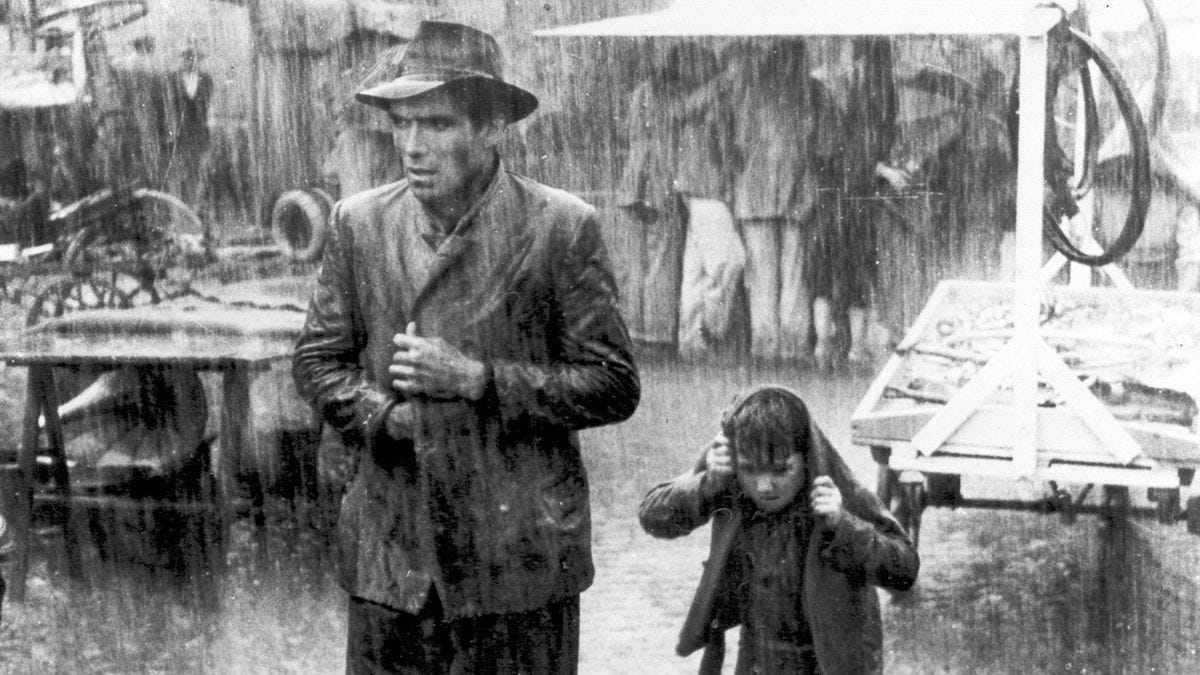
Ultimately, Bicycle Thieves is like a ride through the city in which it is set—one famous for having seven hills. There are ups and downs. Antonio beams alongside his reclaimed bike, buffed and shined by his son, a perfect match for the starched hat and uniform he will wear to his new job. Not long after, he is back in his floppy fedora, wet as a stray dog in one scene and manhandled by a mob in another, as he searches in vain for his lost transportation.
One other way this film is like a ride through Rome. is in its use of actual and metaphorical crossroads. This is, after all, the city to which all roads are supposed to lead. Crossing traffic is a near-constant—a companion to and obstacle in the way of Antonio’s search. On a less literal level, his journey shows us a universe of possible outcomes depending on which path he takes. He can be the working man or the thief—the man who, when gainfully employed, can buy his son Bruno a sandwich and sneak him some wine at a restaurant, and, when not, introduce him, shamefully, to a life of petty crime.
Antonio Ricci is a man on the edge, but he is also a man moving more quickly than he can think. He doesn’t just rush through intersections. He also rushes through Mass, a meeting with an apparent holy woman and prophet, and an underground Communist Party meeting.
Given his predicament and your persuasions, you might wonder why he doesn’t find more time for prayer or for organizing with other would-be workers. Perhaps that is the most powerful point De Sica has to make. For someone like Antonio, there is no time for catechism or class consciousness. Perhaps there should be, but, you know, he has a family to feed first.