


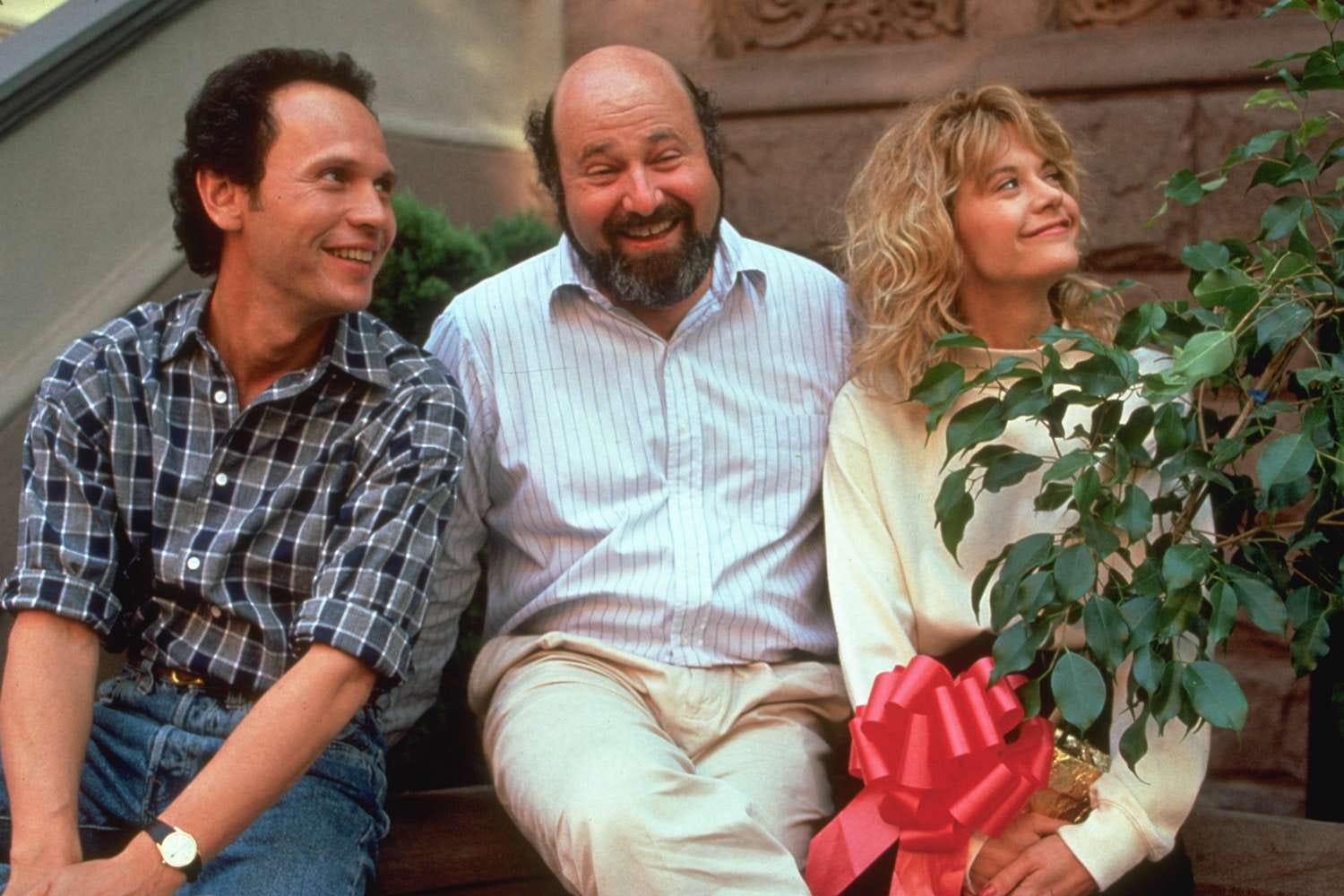
A few weeks from now, my wife and I will watch When Harry Met Sally … as we have on every New Year’s Eve since we decided being out with the crowds no longer had any appeal to us.
We put our kids to bed and make French 75s, a totally incongruous cocktail choice for a middle-aged couple cuddled up on their couch and bedecked in athleisure. We time the start of the proceedings so that Billy Crystal is done telling Meg Ryan that he wants “the rest of his life to start as soon as possible” a few minutes before the real ball drops in Times Square.
It is a modest tradition, I suppose. Nevertheless, it has become one of my most cherished ones. When Harry Met Sally …, of course, has a natural tie-in to the holiday. But, mostly, its appeal is its warmth and unflinching optimism on the subject of love. It gets us to end every year laughing deeply together because the jokes are very funny, but also because they are told in service of real wisdom: friendship as the bedrock of lasting romance, patience as the ultimate virtue, flaws and imperfections being things not to get over so much as they are avenues for deeper understanding and admiration.
Why bother with movies at all? Because of films like this, which do nothing less than make you feel less lonely for a little while.
I am, of course, writing this because Rob Reiner, the director of When Harry Met Sally … and a passel of other films that are held in similarly high regard was murdered in his home along with his wife Michele over the weekend.
This is a shocking and senseless tragedy—one I am finding especially difficult to process, not just because of the nature of it, or because I love so many of his films, but also because Michele specifically is the reason that When Harry Met Sally … ended up ending the way it did.
Social media is flooded with clips of Reiner’s films and also many, many interviews. You don’t have to look far or hard to hear him explain that he changed the ending of When Harry Met Sally … after falling for Michele during the shooting of the film.
It is too plain to think of this as art imitating life. This is a real-life romance changing the course of cinematic history. Is When Harry Met Sally … even on the list of great romantic comedies without that ending—without Michele? What even is the archetype of romantic comedy without this film, just as it is? It would be something foreign, alien, totally different. It’s a good thing fate intervened.
This isn’t something I knew until this week. Sadly, now that I do, it makes what happened to Rob and Michele that much more heartbreaking.
One of the other clips I’ve watched a few times is of Reiner explaining that he learned it was possible to fuse elements of comedy, drama, horror, and so on in one piece, and that the pursuit of that is what animated him professionally.
This, I think, explains the broad appeal of his individual films as well as the remarkable range he displayed over the course of his career.
“That’s capturing the human experience,” Reiner says in the clip above, explaining what he aimed to accomplish with is work. “Because it’s tragic and it’s dramatic and it’s funny too. And if you can figure out a way to blend those things, then, to me, that is the most satisfying theater.”
Well, he did what he set out to do.
Even in his funniest films, there is darkness. Think, for example, of the arc of Buttercup, who becomes earnestly suicidal when she learns Westley is still alive and believes she’ll be forced to marry Prince Humperdinck. Or, sticking with The Princess Bride, consider the backstory and prime motivation of Inigo Montoya. It is funny how he explains his quest to avenge his father, but there is a real sadness in Mandy Patinkin’s eyes when he is delivering the explanation.
It is, of course, there in When Harry Met Sally … too.
“When I buy a new book, I always read the last page first,” Billy Crystal’s Harry tells Meg Ryan’s Sally. “That way in case I die before I finish, I know how it ends. That, my friend, is a dark side.”
This is right after they first meet, on their road trip from Chicago to New York. Harry is playing the part of worldly man lecturing naive young woman, and it seems in the moment that he must be telling a tall tale to make a point.
It is only much, much later—after Harry and Sally get together and then can’t seem to make it work—that we learn he was being entirely serious. Lonely in his apartment and lamenting the mistakes he’s made, we see him do the thing he claimed he did all those years prior, flipping to the last page of a book before turning all the way back to the beginning.
Harry really does have a dark side. We all do, don’t we? It’s confirmed in this one, small moment, and with that confirmation comes a new clarity about the stakes for these two characters in whom we have invested so much. Harry is staring at a dark prospect—an abyss of loneliness if he can’t figure things out with someone who is so obviously right for him.
It still plays for laughs, but When Harry Met Sally … is great because of its unique blend of the human experience. The laughs are just the veneer.
In a way, Harry’s compulsion for reading the last page first serves as a metaphor for his inability to focus on the things that really matter, yet are staring him right in the face. The ending isn’t really what makes a book good or bad. It’s just where it stops. The whole point of reading isn’t to finish, but to begin and then to keep going.
So it is with romantic partnership. And, so, it must sadly be said, it ought to be with Rob Reiner. His last page isn’t what matters. It's all the ones before it.