


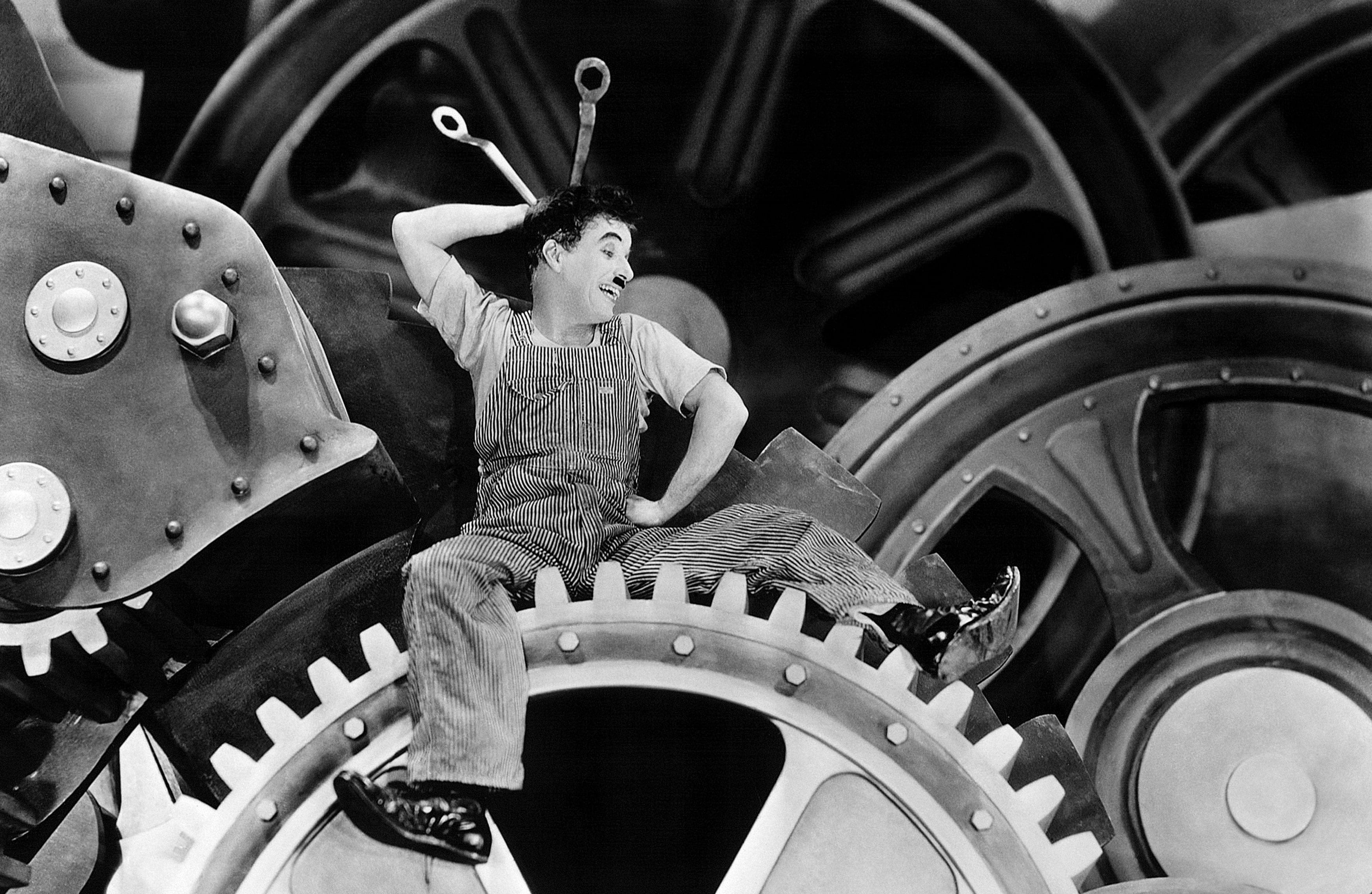
In the very first sequence of Modern Times, Charlie Chaplin’s iconic Little Tramp slithers and oozes his way through the cogs in an enormous, non-descript factory machine. It is as if the matter of which this man is composed has changed state. He is, for a moment, a liquid or a gas coursing through and around massive gears, all bendy—utterly and totally malleable.
This is the first pointed visual metaphor in a film where they come thick and fast. As those visuals accumulate, they gain power and the film gathers momentum thematically. It’s a nice thing that the film picks up this kind of steam, but, the truth is, it’s purely a bonus. Modern Times is a work of genius before its deeper meaning even begins to cross your mind.
That genius can not be separated in any real way from the genius of Chaplin himself, which itself is a kind of genius that doesn’t even feel like it fits properly in the world of film. To watch Charlie Chaplin at the peak of his powers is not so much worthy of comparison to other great actors and is far more worthy of comparison to the most transcendent of athletes.
Right now, tennis player Carlos Alcaraz is my favorite athlete to watch. He is, I would argue, transcendent. And he is not because he is brilliant at what he does, but because he seems to routinely do things on the court that bend the laws of time and space to his will, whether with a ball, a racquet, or his legs. To watch Carlos Alcaraz is to anticipate magic, to witness its inevitable arrival, and to guzzle down amazement as your brain tries to process what your eyes have just seen.
So it is with Charlie Chaplin.
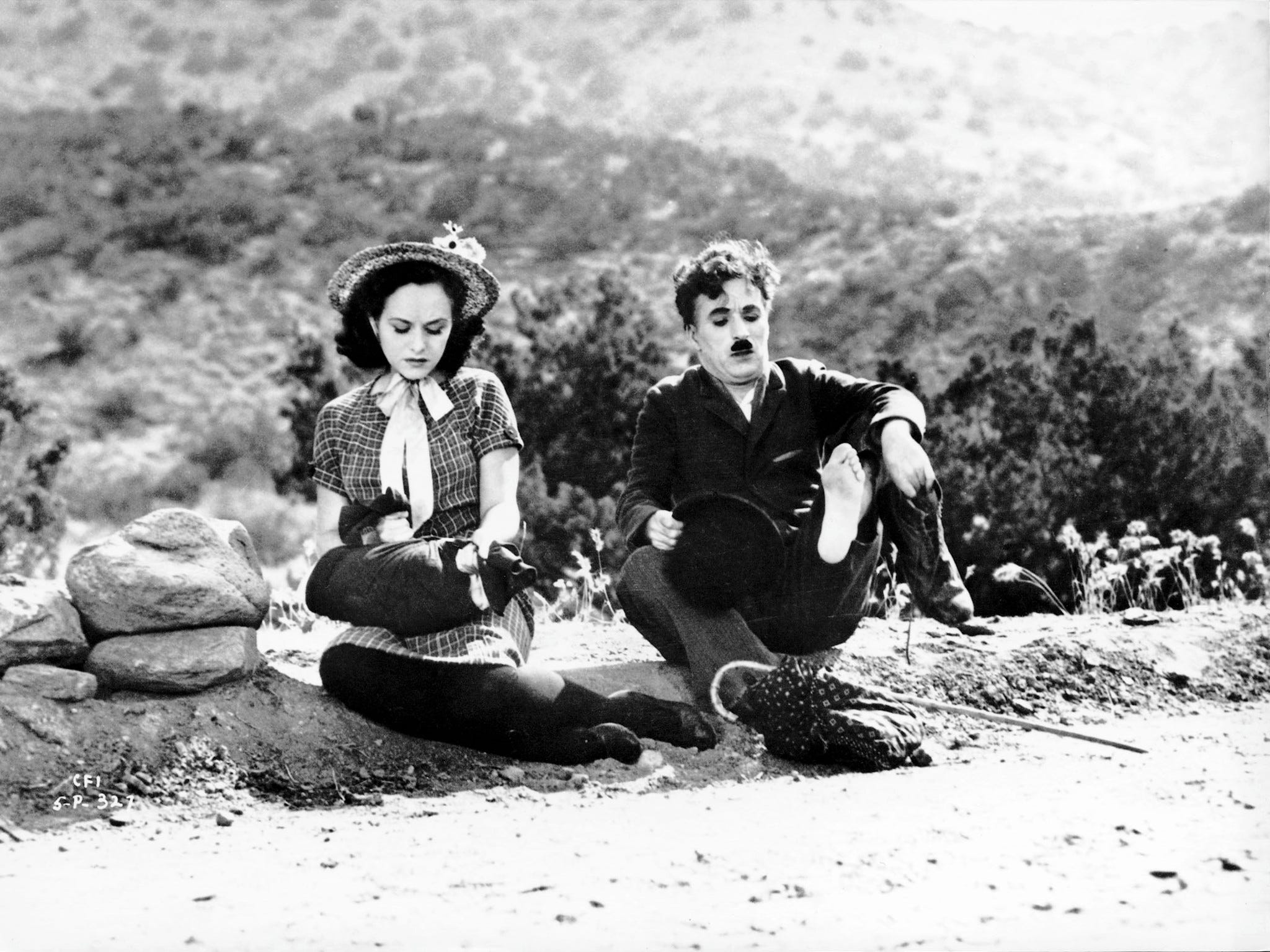
Much later in the film, there is this scene in a department store where he roller skates with a blindfold on. Unbeknownst to his character, there is a multi-story drop perilously close to his path. Chaplin glides in and out of range of the drop. Even watching at home, alone, you can practically hear a crowd of moviegoers gasping with concern and then squealing with delight as he figure-eights his way in to danger and then out again.
In both scenes, there are optical illusions. In the skating scene, Chaplin is passing by a matte painting, not an actual hole in the ground. In the machinery scene, as in all others in the film, the silent speed (18 frames per second) is being projected at the sound speed (24 frames per second), quite literally speeding the action up, and making everything feel even more slapdash. These effects heighten the overall experience as opposed to accounting for the entirety of the sensation. You could give Carlos Alcaraz a wooden racquet, and he would still be a marvelous tennis player. Here, we have Chaplin colliding headlong with the era of “talkies,” and he too is just as marvelous as ever.
Indeed, with Modern Times, Chaplin is using an outgoing approach to film to skewer a cresting, crashing wave of modernity. It is fitting, isn’t it, that The Little Tramp, in his final appearance, is deployed in this particular way after more than two decades as an iconic cinematic figure.
And what does he have to tell us? Well, mostly that we should watch out for a ruling class that will do pretty much anything to dominate the rest of us. Plot-wise, Modern Times is the story of a man who wants to be anything but a cog in a machine—who wants to be left well enough alone—but truly struggles to find any peace despite his best efforts.
The boss at The Little Tramp’s factory surveils him via television monitors while doing a jigsaw puzzle, even when The Tramp is taking a piss. When he gets fired, he is almost immediately and wrongly imprisoned after he’s swept up in a Communist street protest. In jail, he finds the conditions preferable to those in his factory but, after a good deed, isn’t allowed to stay and winds his way back to the factory. There, things become somehow even more dehumanizing, culminating in the adoption of a force-feeding machine that mitigates the need for breaks on the line by literally shoving food down workers’ throats.
In other words, Modern Times predicted the modern times that have extended from the moment it was shot to the moment we are in presently. I share all of the anxieties laid bare by Chaplin in this film. I may not work on a factory floor, but, moment after moment, I feel hounded by surveillance or like a cog in some vast apparatus that I don’t fully understand.
Chaplin’s film offers hope, but not blind optimism. The ending of Modern Times suggests that it is our bonds with other people that will steel us against these kind of relentless incursions on our humanity. Given the looping nature of the story, Chaplin does not seem to be suggesting that this alone will guarantee success. Instead, he seems to be saying that sticking together is all we really have as a means of combat, and that it is all that is really worth pursuing.