


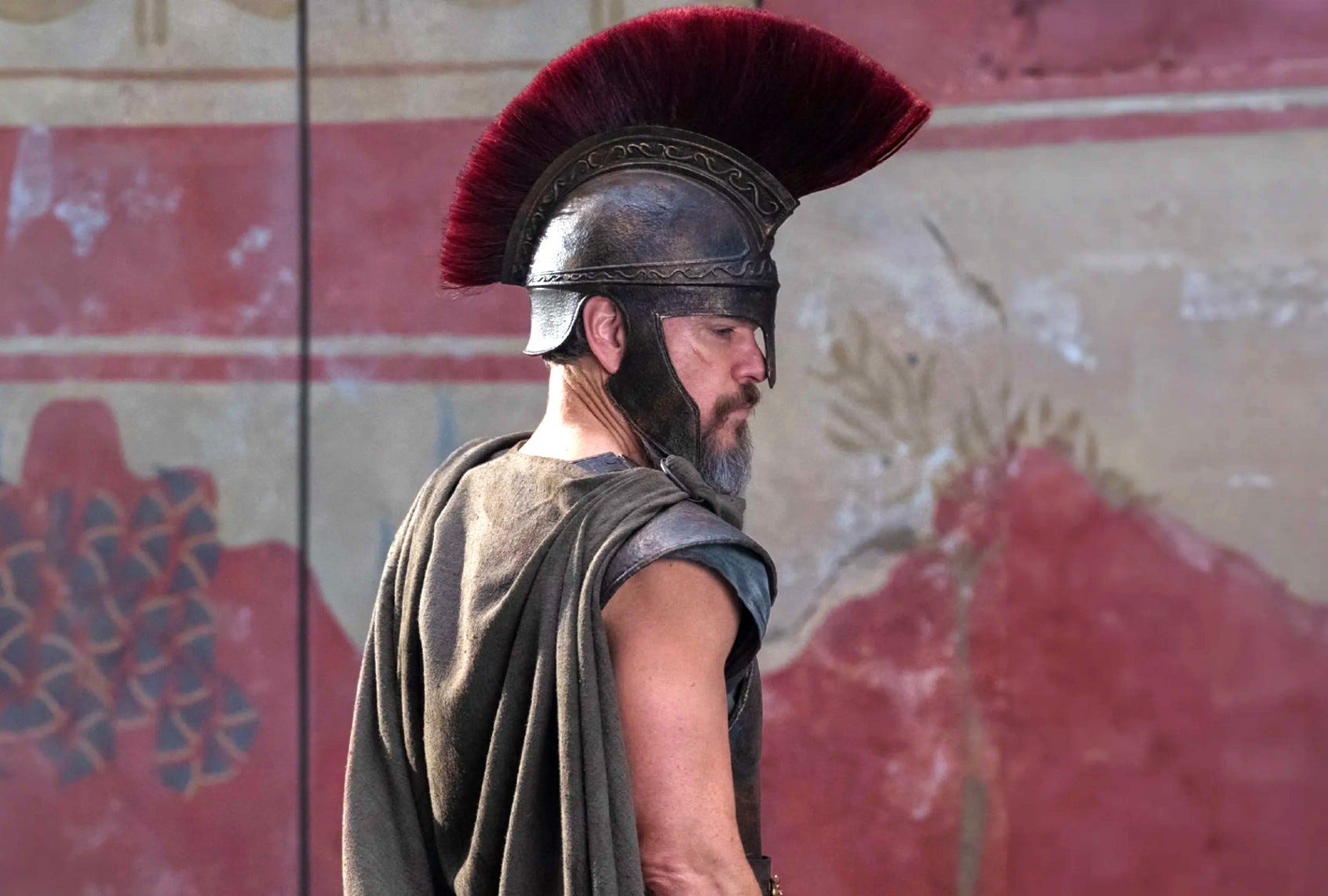
Christopher Nolan is one of our greatest living film directors, and is probably the only one on that short list currently operating at the peak of his powers. The Odyssey is, as Wikipedia puts it, “one of the oldest surviving works of literature and remains popular with modern audiences.”
Small wonder, then, that Nolan’s film adaptation of such a beloved, resonant tale is precisely what you’d expect it to be. To be clear, this is high praise, not backhanded criticism. Nolan’s version of The Odyssey did not blow me away exactly. I don’t yet know where it falls among his other works. What I do know is that Nolan was the right man—maybe the only one alive—for this particular job.
He makes your heart race as Odysseus escapes from Cyclops’ cave. He meditates on everything from social decay to attempts to defy fate to the feeling that you’re running out of time. He puts it all in a non-linear blender that makes this story we all know more human and more fraught.
All of this is wonderful. Sometimes, it is easy to chase the thing that smashes beyond your low expectations or to lament the thing that falls well short of your high hopes, all of which can obscure something that just delivers.
I don’t know that I thought much about what Christopher Nolan’s version of The Odyssey would be in the run-up to the film’s release—probably in no small part because once right-wing trolls began to soil themselves over context-free casting news I resolved to tune it all out.
But, after seeing it, one of my immediate impressions was that this is the film I would have wanted and expected had I given it much thought at all.
If there is one big surprise, it might be that while Nolan’s marks are all over this film, it is still very much The Odyssey as told by Christopher Nolan, as opposed to Christopher Nolan’s The Odyssey.
Some of the legitimate criticism of the film has centered on the very American accents used by the cast and the imposition of Christian morality on a very pagan story. My impression is quite the opposite (our podcast episode covering this in more detail.)

Sure, the mores and anxieties of today are right there for your engagement and interpretation. But I personally found this to be a quite conventional adaptation of the source material, in the best possible way. If anything, The Odyssey occasionally drowns out the familiar tics and hobby horses of a director whose body of work has made his name a brand.
In the context of Nolan’s work, this is refreshing. He finds time to pick up threads from Oppenheimer (a clever man drowns in regret when more powerful men use his smarts for their own morally questionable ends), and The Dark Knight (what it means to act heroically in a place where the social contract has been broken), and even Interstellar (losing time with a parent who has taken up a mission with an ostensibly “higher” calling).
Mostly, though, Nolan seems to be serving the source material by making it at once epic and intimate. For a story that has endured millennia, that only seems right.